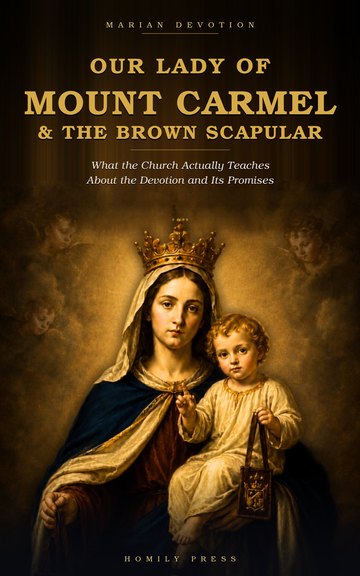
Cover of Our Lady of Mount Carmel and the Brown Scapular
A devotion explained · For wearers of the scapular

Our Lady of Mount Carmel and the Brown Scapular

What the Church Actually Teaches About the Devotion and Its Promises

Millions wear the brown scapular, and few have been told what the Church teaches about it. This book gives the history, the theology, and the promises, read with the Church.

$4.99Kindle eBook on Amazon.com · Available now
  • Reads on any phone, tablet, or Kindle
  • Delivered in seconds
  • Seven chapters, a conclusion, and six appendices
Why this book

The cloth, and what stands behind it.

Most of those who wear the brown scapular can say three things about it: it comes from Our Lady of Mount Carmel, it is tied to Saint Simon Stock, and it is said to promise salvation to whoever dies wearing it. The first is devotion, the second is a tradition with a history of its own, and the third needs careful reading.

This book follows the devotion from the prophet Elijah on Mount Carmel, through the hermits who became an Order, to the tradition of Saint Simon Stock and the Church’s teaching on the scapular as a sacramental. It reads the promises, including the Sabbatine Privilege, with the Church, and closes with practical guidance for wearing the scapular today.

What you will find

Inside Our Lady of Mount Carmel and the Brown Scapular

  1. 01

    The history, from the sources

    Mount Carmel and the fire of Elijah, the hermits and the Rule of Saint Albert, and the Order that took Mary’s name.

  2. 02

    Simon Stock and the origin of the scapular

    What tradition tells of Saint Simon Stock and the scapular, and where firm history ends and pious tradition begins.

  3. 03

    The promises, read with the Church

    What the Church teaches about the scapular as a sacramental, and a careful reading of the promise about death and the Sabbatine Privilege.

  4. 04

    Wearing it today

    Enrollment, the rite, consecration to Mary, and the common questions answered in plain words.

Free sample

Read the opening of Chapter I

Before you buy, read how the book begins: a mountain above the sea, and the prophet whose story the devotion echoes.

Chapter I

Mount Carmel and the Fire of Elijah

Before it was a devotion, Carmel was a place. It exists, it can be visited, it has coordinates, vegetation, and a wind off the sea. A traveler who lands in Israel and heads north toward the city of Haifa meets a range of mountains that runs almost to the water, dividing the coastal plain from the interior of Galilee. This is Mount Carmel.

The name means something close to garden or orchard in Hebrew, a fertile land, and the mountain earns it. Much of the Holy Land is dry and stony, yet Carmel keeps green slopes, springs, caves, and a freshness that sets it apart from the country around it.

This first fact has to be fixed in mind before any other. The devotion of Carmel took root in a particular mountain and in the memory of a man who lived on it.

Take Carmel out of geography and treat it only as a symbol, and its force is lost. The symbol came later, and it came because a land and a story were already there.

The story that gives Carmel its soul is told in the First Book of Kings, and its protagonist is the prophet Elijah. The setting is the kingdom of Israel under King Ahab, married to Jezebel, a foreign princess who brought into the nation the worship of Baal, the Canaanite god of fertility and rain. The kingdom had abandoned the Lord of its fathers and given itself to gods who did not exist. Fidelity, once the duty of all, had become the cause of a few, and Elijah stood almost alone.

Elijah proposed a trial before all the people, and the place he chose was Carmel. The scene, told in the eighteenth chapter of the First Book of Kings, is among the most dramatic in all of Scripture.

The book continues on Kindle.

Liked the beginning? The whole book is on Kindle.

Buy on Amazon · $4.99
Contents

Seven chapters, a conclusion, and six appendices

Behind the brown cloth stand a mountain, an Order, a saint, and a long line of Church teaching. Homily Press tells the history as far as the sources go, and says plainly where tradition takes over.

The book is written with its sources in view, and Appendix I gathers the source texts in translation, so the reader can see what is quoted and from where.

Download the free Reader’s Companion (PDF)

  1. To the Reader
  2. Chapter I: Mount Carmel and the Fire of Elijah
  3. Chapter II: The Order Born Under Mary’s Name
  4. Chapter III: Saint Simon Stock and the Origin of the Scapular
  5. Chapter IV: The Scapular as Sacramental: Clothed in Mary
  6. Chapter V: The Promises Read with the Church: Death and the Sabbatine Privilege
  7. Chapter VI: The Scapular as Consecration to Mary
  8. Chapter VII: Wearing the Scapular Today
  9. Conclusion: The Cloth and Its Meaning
  10. Appendix I: Source Texts
  11. Appendix II: Glossary
  12. Appendix III: Liturgical Calendar of Carmel
  13. Appendix IV: Annotated Bibliography
  14. Appendix V: Places of Devotion to Our Lady of Mount Carmel
  15. Appendix VI: Living the Devotion: Rite, Prayers, and Common Questions
Inside the edition

Prayers and practice you will keep using.

Chapter VII and Appendix VI turn the history into practice. The prayers are brief and can be said in any place.

Putting it on

A Prayer for Receiving the Scapular

A short prayer of entrustment to Mary, in the sober liturgical English of the house.

Each day

A Short Prayer of Renewal

A single sentence to renew your consecration whenever you put on the scapular.

The rite

The Rite of Enrollment Explained

Who may enroll you, what the words are, and why it happens only once.

Questions

Common Questions Answered

Children, a lost scapular, the scapular medal, and what to do if you forget to pray.

Who it is for

This book is for you if...

  • You wear the scapular and have never been told what it means.
  • You have heard promises about it and want to know what the Church actually teaches.
  • You want to see where history ends and pious tradition begins.
  • You want the rite, the prayers, and the common questions in one place.

Perhaps not for you if

  • You want the leaflet version, in which the cloth guarantees salvation whatever the life of the wearer.

It promises no particular outcome, and it makes no claim of ecclesiastical approval for this edition.

Why you can trust this edition

Made by people, checked at the sources.

This English edition is prepared by Homily Press from a book already read by Catholics in Brazil and published by Editora Homilias. References to Church documents are checked against official texts, and no line is attributed to anyone without a located source.

  • ScriptureQuoted in this edition’s own wording, faithful to the sacred text
  • Church documentsCited from official texts of the Holy See
  • History and traditionFirm history marked apart from pious tradition
  • Plain limitsNo promised results, no claimed approval
Questions

Before you read.

Is it true that anyone who dies wearing the scapular is saved?

The Church does not teach that the cloth works on its own. The scapular is a sacramental that places the wearer under Mary’s care and calls for a life of faith. Chapter V reads the promise in full, with the Church.

Did Our Lady really appear to Saint Simon Stock?

Tradition says so, and the book tells the scene as devotion has handed it down. It also says where the early evidence stops, so the reader can tell firm history from pious tradition.

Does the book explain how to be enrolled?

Yes. Appendix VI gives the rite of enrollment, two short prayers, and answers to common questions, such as what to do if you lose your scapular.

Continue reading

More from the Press.

Cover of Magnifica HumanitasNew

Magnifica Humanitas

A Study Edition on Pope Leo XIV's Encyclical on Artificial Intelligence and the Dignity of the Person

Pope Leo XIV's first encyclical, followed chapter by chapter, with a clear line between permanent teaching and prudential judgment.

Kindle · $6.99 · Kindle Unlimited

Cover of Mary, Undoer of KnotsNew

Mary, Undoer of Knots

The Story of the Devotion, the Teaching of the Church, and a Nine-Day Novena

The painting in Augsburg, the teaching behind the devotion, and a nine-day novena, one knot a day.

Kindle · $3.99 · Kindle Unlimited

Cover of The Four Last ThingsNew

The Four Last Things

What the Catholic Church Teaches About Death, Judgment, Purgatory, Hell, Heaven, and the End of the World

Death, judgment, purgatory, hell, and heaven, each doctrine placed at its proper level, with no timetable for the last days.

Kindle · $5.99 · Kindle Unlimited

Our Lady of Mount Carmel and the Brown Scapular$4.99 · KindleBuy on Amazon