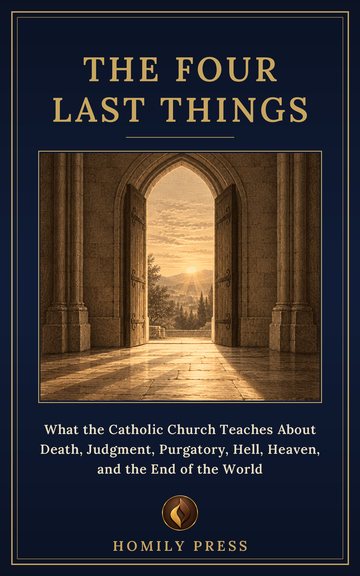
Cover of The Four Last Things
Doctrine Collection · Volume I

The Four Last Things

What the Catholic Church Teaches About Death, Judgment, Purgatory, Hell, Heaven, and the End of the World

Every Catholic recites the Creed and professes the resurrection of the body and life everlasting. Few have ever been shown how the whole teaching fits together.

$5.99Kindle eBook on Amazon.com
Free with Kindle Unlimited
  • Reads on any phone, tablet, or Kindle
  • Delivered in seconds
  • About 2 hours
Why this book

A faith that does not think about its end soon thinks about nothing deeply.

The four Last Things once held a central place in Catholic life. Today many Catholics know there is a beyond and cannot describe it, and they meet the death of a loved one with questions they have never examined.

Into that silence came two substitutes: books of prophecy that sell fear, and the quiet assumption that in the end nothing is at stake. This book sets out what the Church actually teaches about death, judgment, purgatory, hell, and heaven, and how certainly she teaches it.

What you will find

Inside The Four Last Things

  1. 01

    Four levels of certainty

    Every claim is marked as defined dogma, open theological opinion, private revelation, or condemned error.

  2. 02

    The questions people ask

    What happens at the moment of death, how purgatory purifies, how the Church can teach hell and still hope for every soul.

  3. 03

    The end of the world, soberly

    The Second Coming, the Antichrist, the errors about the millennium, and the new creation, with no timetable.

  4. 04

    Help for the reader

    A summary at the end of each doctrinal chapter, frequent questions, two traditional prayers, and a glossary.

Free sample

Read the Introduction in full

Before you buy, read the opening of the book: why the silence about the last things needs to be broken, and for whom this book was written.

Introduction

The four Last Things once held a central place in Catholic life. They were preached from the pulpit, recalled in parish missions, repeated in the catechisms, and carved into the very stone of the churches, where the Last Judgment covered whole walls so that no one could forget it. The Christian knew that he would die, knew that he would be judged, and ordered his life from that knowledge.

Death was the horizon that gave meaning to everything before it, and that horizon has faded from common conversation. The doctrine remains what it was, because it cannot change, and the subject has left the stage. Preaching today often dwells on mercy and consolation and says little of judgment, warning, or the road that leads to heaven.

The reasons for the silence are understandable. Preaching that wielded hell like a whip, that measured holiness by fright, and that confused conversion with panic left scars, and the reaction against those excesses was in part just. It ran too far, however. To avoid frightening, the subject was dropped, and to avoid gloom, it was omitted.

The result is a Catholicism that knows there is a beyond and cannot describe it, and that meets the death of a loved one with questions it has never examined. Into the vacuum left by serious preaching, two substitutes advanced.

The first was sensationalism, with books of prophecy, chronologies of the end of the world, and private visions treated as if they weighed as much as the Gospel. The second was dissolution, the idea, rarely stated outright but widely assumed, that in the end everyone is saved anyway, that hell is empty, and that the moral life decides nothing.

The two tendencies seem opposite, yet both spring from the same root, the loss of the Church's sober teaching, which names every truth at its proper weight and trusts the reader to receive it as an adult. This book is written to fill that void.

It is addressed to the adult Catholic who wants the truth without fantasy: what the Church teaches, how certainly she teaches it, and what remains an open question within the faith. Many such readers look for a book like this and cannot find one, because the field swings between the technical manual and the literature of anxiety, which sells fear wrapped in devotion.

These questions press on every conscience, even that of one who has never entered a church. What happens at the moment of death? Is there a judgment, when does it take place, and by what standard? Is hell real, and is anyone there? What does purgatory mean, and why do we pray for the dead? What is the happiness of heaven, and is it the same for everyone?

The Catholic has access to the most precise answers that exist, guarded and refined by twenty centuries of reflection under the light of Revelation. These pages offer doctrine set out with care, distinctions kept with rigor, and a hope that has no need to lie about the gravity of things in order to stand.

The reader will find strong assertions, because the faith makes them. The reader will also find frank limits, the points on which the Church has not defined and on which prudence forbids going beyond what has been revealed.

Above all, the reader will find Christ. Death was conquered by someone, judgment will be rendered by someone, and heaven is the presence of someone. The Christian looks at his end as one who awaits a Person, who has already waited for him first on the cross.

The first chapter places the Last Things within the whole of the faith, and the chapters that follow take the four final ends one by one, patiently separating dogma, debate, devotion, and error. The Press asks of the reader a single disposition: to take seriously the most serious subject there is, because on it depends, literally, everything.

The book continues on Kindle.

Liked the beginning? The whole book is waiting on your Kindle.

Buy on Amazon · $5.99
Contents

Fourteen chapters in five parts

This is a sober book about what the Church teaches on death, judgment, purgatory, hell, heaven, and the end of the world. It is not a guide to prophecy, and it offers no timetable for the last days. Each doctrine is placed at its proper level: defined dogma, open theological opinion, private revelation, or condemned error. A reader can finally tell what he must believe, what he may discuss, and what he is free to leave aside.

Homily Press follows the sources. It quotes the Catechism, the councils, and Scripture, and it takes up the questions that unsettle serious Catholics: what happens at the moment of death, how purgatory purifies, how the Church can teach eternal hell and still hope for every soul, what the Antichrist and the Second Coming mean, and how to read Fatima without turning an apparition into a doctrine.

  1. Editor's Note
  2. Introduction
  3. Part I: How to Read This Book
  4. Chapter I: The Last Things and Their Place in the Catholic Faith
  5. Chapter II: The Map of the Four Levels
  6. Part II: Death
  7. Chapter III: The Nature of Death
  8. Chapter IV: Christian Death
  9. Part III: Judgment
  10. Chapter V: The Particular Judgment
  11. Chapter VI: The Universal Judgment and the Resurrection of the Flesh
  12. Part IV: The Definitive States and Purification
  13. Chapter VII: Purgatory
  14. Chapter VIII: Hell: Existence and Eternity
  15. Chapter IX: Hell: The Legitimate Debates and the Condemned Errors
  16. Chapter X: Paradise: The Beatific Vision
  17. Chapter XI: Paradise: The Communion of Saints and the Degrees of Glory
  18. Part V: The Consummation
  19. Chapter XII: The Parousia, the Antichrist, and the Errors About the Millennium
  20. Chapter XIII: The New Creation: New Heavens, New Earth, and the Glorious Body
  21. Chapter XIV: Fatima and the Last Things: How to Read an Apparition
  22. Conclusion: Living in the Light of the Last Things
  23. Appendix A: Frequently Asked Questions and Two Traditional Prayers
  24. Appendix B: Glossary of Terms and of the Four Levels
Inside the edition

Ten engravings in the style of the nineteenth century

Each part of the book opens with an engraving, from the deathbed candle to the road toward the morning light.

The Last Things, engraving from the book
The Last Things
Death, engraving from the book
Death
Judgment, engraving from the book
Judgment
Purgatory, engraving from the book
Purgatory
Paradise, engraving from the book
Paradise
Living in the light, engraving from the book
Living in the light
Who it is for

This book is for you if...

  • You want the Catholic teaching on death, judgment, heaven, and hell set out clearly.
  • You want to know how firmly each statement is held.
  • You have lost someone and want serene answers about what comes after death.
  • You study or teach the faith and need precise references to the Catechism and the councils.
  • You want to be neither frightened nor deceived about hell and purgatory.

Perhaps not for you if

  • You are looking for predictions about the end of the world. Private revelations such as Fatima are treated as pastoral helps, never as articles of faith.

The Press makes no claim of ecclesiastical approval for this edition.

Why you can trust this edition

Made by people, checked at the sources.

This English edition is prepared by Homily Press from a book already read by Catholics in Brazil. Every doctrinal statement is weighed against Scripture, the Catechism, and the documents of the Magisterium, and no line is attributed to anyone without a located source.

  • ScriptureRevised Standard Version, Second Catholic Edition
  • Church documentsOfficial English texts of the Holy See
  • DoctrineDogma kept apart from opinion and private revelation
  • HonestyNo promised results, no claimed approval
Questions

Before you read.

Does the book predict the end of the world?

No. It is not a guide to prophecy, and it offers no timetable for the last days.

How does it treat Fatima and other apparitions?

As private revelation, read with the caution the Church asks, without turning an apparition into a doctrine.

Is it written for theologians?

It is written for adult Catholics. Each doctrinal chapter closes with a short summary, and a glossary explains the terms.

Continue reading

More from the Press.

Cover of Magnifica HumanitasNew

Magnifica Humanitas

A Study Edition on Pope Leo XIV's Encyclical on Artificial Intelligence and the Dignity of the Person

Pope Leo XIV's first encyclical, followed chapter by chapter, with a clear line between permanent teaching and prudential judgment.

Kindle · $6.99 · Kindle Unlimited

Cover of Mary, Undoer of KnotsNew

Mary, Undoer of Knots

The Story of the Devotion, the Teaching of the Church, and a Nine-Day Novena

The painting in Augsburg, the teaching behind the devotion, and a nine-day novena, one knot a day.

Kindle · $3.99 · Kindle Unlimited

The Four Last Things$5.99 · Kindle UnlimitedBuy on Amazon