

An Encyclical and Its Moment
On May 25, 2026, Pope Leo XIV’s first encyclical was presented to the world at a press conference in the Vatican, days after it was signed. The makeup of the panel that presented it already said something about the document. Alongside the prefects of the competent dicasteries and invited theologians sat a cofounder of one of the most influential companies developing artificial intelligence.
A letter on safeguarding the human person in this age was placed, from the first hour, in dialogue with those who build the very technology it addresses, never treated as an internal matter of the Church alone.
The scene dispels a common misreading. The Church came to this subject as a participant in the transformation, and it met the moment with a language that goes beyond warning. It sat at the same table with those who think through the dignity of the person and with those who design the systems, a sign that it means to be heard, and to listen, at the center of the debate rather than at its margin.
That this was so from the very presentation of the text sets the tone for the whole encyclical, which favors discernment over anathema.
Consider first what one holds in hand. The word encyclical comes from the Greek for a letter meant to circulate, to travel a circle of churches and readers. It is an act of the ordinary magisterium, the habitual teaching by which the Successor of Peter guides the faith and life of the faithful, and not an isolated decree or the Pontiff’s private opinion.
This teaching, even where it does not solemnly define a dogma, asks of the Catholic what tradition calls the religious submission of intellect and will, because the one speaking is the shepherd entrusted with confirming his brothers and sisters in the faith. Whoever opens an encyclical stands before a word the universal pastor addresses to the whole Church, one that calls for attentive listening before any judgment.
From this follows a distinction the reader needs to carry through this entire book, on pain of misreading every page of the encyclical. Not everything a social document states carries the same weight. Some statements restate, in new words, permanent truths of the faith: the dignity of the human person, created in the image of God; the sacred value of work; the moral law written on the heart.
These truths do not change, and no technology repeals them. Alongside them, though, sits the prudential application of those truths to a concrete and shifting situation: how to assess artificial intelligence, the markets, the forms of regulation, the risks of a particular historical moment.
This second plane admits legitimate discussion among Catholics of good will, who share the same principles and differ on how to embody them. Confusing the two planes is the most common error made by commentators on a magisterial text. Treating a prudential reading of a circumstance as if it were untouchable dogma hardens what the Church left open.
Treating a permanent truth as if it were a dated opinion dissolves what the Church has established. Magnifica Humanitas itself warns against this confusion when it describes social doctrine as a living body of truths, one that preserves the essential and interprets the new, and never as a static set of concepts. Distinguishing the two planes follows the document’s own inner structure.
It is also the service this book intends to render, and the reason it keeps returning to the line between the permanent and the prudential.
Once this is understood, the next question presses almost on its own. Why does a Pope write on artificial intelligence, and why this Pope, under this name, at this moment? The answer begins with a choice that drew notice from the first day. Elected on May 8, 2025, Robert Francis Prevost chose to call himself Leo XIV, taking up a name no Pontiff had used since the death of Leo XIII in 1903.
Two days later, meeting with the cardinals, he explained the reason plainly.
Leo XIII, with the historic encyclical Rerum Novarum, had confronted the social question in the context of the first great industrial revolution; today, the new Pope said, the Church offers everyone its heritage of social doctrine to respond to another industrial revolution and to the developments of artificial intelligence, which bring new challenges to the defense of human dignity, justice, and work.
The intention, then, was declared before the document itself existed. The name was already a program.
That program took on an exact date a year later. Magnifica Humanitas was signed on May 15, 2026, exactly one hundred and thirty-five years after the promulgation of Rerum Novarum. The coincidence was deliberate, and reading it as a mere commemorative gesture would miss the point. In choosing that date, the Pope affirms that the task of 1891 and the task of 2026 are the same task.
In both cases, a large-scale technological transformation reorganizes the labor of multitudes and threatens to reduce the person to a cog in a system. In 1891, the system was the factory. In 2026, it is the platform, the algorithm, automation. The terrain changed; the method did not.
The Church continues doing what it learned to do with Leo XIII: reading the present in the light of the Gospel, identifying where human dignity is at risk, and proposing criteria for action. Anyone who reads through the encyclical will notice that Leo XIV repeatedly invokes his predecessor. He does so because he is affirming a deliberate continuity, that of a single doctrine spanning two revolutions.
Even so, one misunderstanding that haunts every discussion of technology needs to be avoided. Magnifica Humanitas is a measured reading of technology, without alarm and without slogans. The Pope refuses the temptation to demonize technology. He recognizes that it has been rooted in human history from the beginning, bound to the freedom and intelligence with which man cultivates and transforms the world he received.
He recognizes that technological development has significantly improved humanity’s living conditions across the centuries. The discoveries of science are presented as a gift entrusted to the person to be made fruitful, in the manner of the talents in the parable. The question, then, is whom this technology serves, and toward what end we direct it.
Here is what the encyclical calls, reviving an old expression, the res novae, the new things of our time. Leo XIII spoke of the new questions industry had opened. Leo XIV observes that digitalization, artificial intelligence, and robotics are transforming the world with unprecedented speed and depth. The decisive fact, though, is the unprecedented nature of this power, which outruns even the speed of the change.
Technology, the Pope writes, is not neutral in itself, because it carries the face of those who conceive it, finance it, regulate it, and use it. A tool capable of healing, connecting, and educating is the same tool that can divide, discard, and generate new injustice, and what decides between one destiny and the other is the heart of the one who wields it. To this the encyclical adds a circumstance it underscores with clarity.
Once it was mainly states that guided innovation. Today, the chief engines of development are private actors, often transnational, holding resources and capacity for intervention greater than those of many governments. Technological power thus takes on a new identity, predominantly private, and for that reason harder to discern, to govern, and to direct toward the common good.
Faced with this, Magnifica Humanitas issues a sober warning, and much of its urgency lies there. If we limit ourselves to reacting to emergencies as they appear, we risk letting a succession of urgent matters decide the direction of the road for us. Most people, the Pope observes, remain waiting, watching from a distance, simply hoping everything will turn out well.
It is to this passivity that the encyclical responds, returning to each person’s conscience questions that can no longer be postponed. Where are we going? Toward what goal do we wish to direct ourselves? What direction should we choose, as a human community and as peoples? These are questions of meaning, beyond what any engineer could answer, and so they belong also, and perhaps above all, to faith.
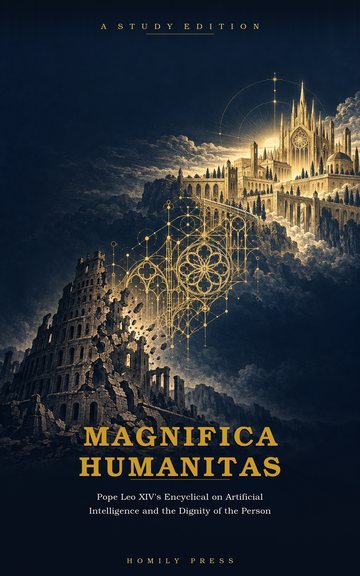
To meet them, the Pope opens the encyclical with an image that will govern the whole rest of the text, and to which the next chapter will be devoted. In the very first line, he describes humanity facing a decisive choice: raise a new tower of Babel, or build the city where God and humanity dwell together. Everything that follows, across five chapters, unfolds that alternative.
On one side, the pride that seeks to reach heaven by its own strength, sacrificing the dignity of persons in the name of efficiency. On the other, the patient and shared labor of those who rebuild, stone by stone, a space worthy of human dwelling together. The reader who keeps both cities before his eyes will understand the whole encyclical. Whoever loses sight of them will read a heap of unrelated themes.
This is also why this book exists, and it may help to say now how it means to be read. In the first days after a document like this is published, hasty summaries multiply, paraphrasing the text without illuminating it. These pages take another course. Magnifica Humanitas is treated here as a school of discernment, never as a prophecy to decode or an alarm to spread. The aim is to place the encyclical within the long tradition of social doctrine, to anchor every central statement in the permanent sources of the faith, in particular the Catechism, and to translate it into concrete discernment for the Catholic who lives, works, raises children, and prays at the start of the twenty-first century.
The reader can always return to the encyclical’s official text, published by the Holy See and indicated in this edition, to weigh the interpretation against the source for himself.
Before the two cities are followed down to their biblical foundation, this first step has established a few things. What is in hand is an encyclical, an act of the ordinary magisterium, one that asks for attentive listening and a reading that tells the permanent apart from the contingent.
It is born of a deliberate choice of continuity, signed on the exact date social doctrine turned one hundred and thirty-five years old, and it answers a technological revolution that, like the first, reorganizes human labor and puts the dignity of the person to the test. Its question concerns whom artificial intelligence will serve and toward what end.
Its answer, before it is argued, is proposed as an image: Babel or Jerusalem. It is to that image that we must now descend.
The book continues on Kindle.