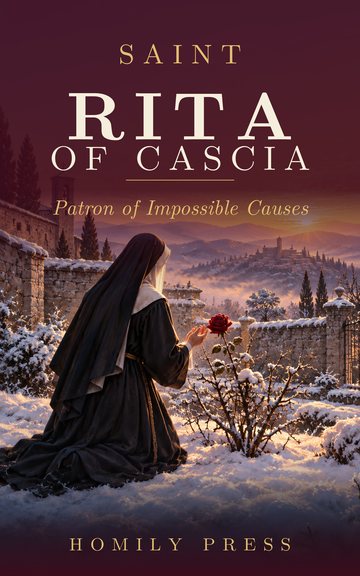
Cover of Saint Rita of Cascia: Patron of Impossible Causes
A saint's life · For impossible causes

Saint Rita of Cascia: Patron of Impossible Causes

Her True Story, What the Church Teaches, and How to Pray with Confidence

When every door seems closed, Catholics around the world turn to a medieval widow and nun of Umbria. This book tells who she was, and how to pray with her.

$4.99Kindle eBook on Amazon.com
  • Reads on any phone, tablet, or Kindle
  • Delivered in seconds
  • Seven chapters, a conclusion, and a nine-day novena
Why this book

The life behind the medal.

Most of those who pray to Saint Rita can say three things about her: she was married and suffered, she bore a thorn on her forehead, and she is the patron of impossible causes. All three are true, and all three are very little.

This book follows Margherita Lotti from the mountain village of Roccaporena through a hard marriage, the murder of her husband, the death of her sons, and the long refusal of the monastery of Cascia. At every step it marks where the documents end and pious tradition begins. Then it explains what the Church teaches about asking the saints to pray for us, and offers prayers and a nine-day novena composed by the Press.

What you will find

Inside Saint Rita of Cascia: Patron of Impossible Causes

  1. 01

    The life, from the sources

    Margherita Lotti of Roccaporena, her marriage, her widowhood, and the Augustinian monastery of Saint Mary Magdalene in Cascia, with firm history and pious tradition clearly marked.

  2. 02

    The thorn, the rose, and the figs

    The scenes of her last winter, told as the tradition tells them and named as tradition.

  3. 03

    From beatification to canonization

    The Church beatified her in 1627 and canonized her on May 24, 1900. The book follows the devotion from there to today.

  4. 04

    How to pray with her

    The novena, the blessing of roses, the medal, the pilgrimage, and what to do while an impossible cause stays impossible.

Free sample

Read the opening of Chapter I

Before you buy, read how the book begins: the white bees of the cradle, and why Christian tradition kept them.

Chapter I

Cascia, Umbria, Fourteenth Century

The first famous scene in the life of Saint Rita is the scene of the bees. It exists in at least two versions, both old.

In the first version it takes place a few days after the baptism. The newborn Margherita lies in her wicker basket in the field while her parents work. A swarm of white bees arrives and settles on the child’s face.

They go in and out of her mouth, leave honey on her lips, and circle her without harming her. The baby does not cry. The whiteness matters, because it marks the event as a sign.

The second version adds a third person. A peasant from the neighborhood, on his way to Cascia, crosses the family’s path. He has badly wounded his hand at work and is looking for help. He sees the basket surrounded by bees and, fearing for the infant, runs to drive the insects away with his injured hand.

At the moment he moves his arm, the wound closes completely. He understands that he stands before something greater than himself, and he goes away healed and silent.

The tradition of Cascia holds that the bees never left Saint Rita. Today the Augustinian monastery points to small holes in a wall beside the cloister stairs where masonry bees live, and popular belief links them to the bees of her cradle.

The Press reports this belief as devotion reports it. Whether the bees of the wall continue the bees of the basket is left to the faith of the reader. As a sign they speak for themselves.

Why did this episode cling so firmly to the memory of Saint Rita? The answer lies in an ancient layer of Christian symbolism. Bees have always been special creatures in the Christian tradition. They are clean. They work in community. They make the honey that sweetens and the wax that lights the altar.

The Easter Exsultet, sung at the Vigil from ancient times, praises the bees by name for the wax they give to the paschal candle. Medieval preachers called the saints spiritual bees who make the honey of virtue.

When tradition places white bees at the cradle of Margherita Lotti, it says without spoken words that this child will make honey for the Church. She will work, she will offer sweetness, she will give light. The detail of the color adds a layer of purity and of heavenly origin. They are bees marked as a sign.

The modern reader, used to separating fact from symbol, may find it strange that the Church guards so carefully a scene so plainly symbolic as a proof of someone’s holiness. For the medieval Church the symbol was a form of fact.

When God wishes to say something about a life, he speaks in the language that people understand, and the language of white bees was, for an Umbrian peasant of the fourteenth century, perfectly clear. It said: here God is at work.

The book continues on Kindle.

Liked the beginning? The whole book is waiting on your Kindle.

Buy on Amazon · $4.99
Contents

Seven chapters, a conclusion, and four appendices

Behind the medal, the thorn, and the title stands an entire life, lived in Umbria at the turn of the fourteenth and fifteenth centuries, with a family name, a house, a husband, two sons, and a convent. The leaflet life says that she suffered much and heals those who pray. The academic life dissects the hagiography until little remains of it. Homily Press offers a middle course for the adult reader.

The book is written with its sources in hand. The best known early one is the Life composed by the Augustinian Agostino Cavallucci of Foligno, published in Siena in 1610 and drawn from the oral tradition of Cascia. Beside it stand the studies of modern scholars on the surviving documents. Where tradition supplies a concrete scene that no document close to the events confirms, the book says so and tells the scene as devotion has handed it down.

  1. Editor's Note
  2. Prologue
  3. Chapter I: Cascia, Umbria, Fourteenth Century
  4. Chapter II: The Wife, the Mother, the Widow
  5. Chapter III: The Nun of Cascia
  6. Chapter IV: The Thorn
  7. Chapter V: The Roses, the Figs, the Death
  8. Chapter VI: From Beatification to Canonization
  9. Chapter VII: Praying with Saint Rita Today
  10. Conclusion
  11. Appendix I: Prayers and Novena of Saint Rita of Cascia
  12. Appendix II: Glossary
  13. Appendix III: Calendar of the Devotion
  14. Appendix IV: Further Reading
Inside the edition

Prayers you will keep using.

Chapter VII and Appendix I turn the life into practice. The prayers are brief and can be said in any place.

Any place

Prayer for Impossible Causes

A prayer in the sober liturgical English of the house, which asks for help and makes no demand.

A short devotion

Fifteen Hail Marys

A brief devotion that can be taken up at any time of the year.

Nine days

A Novena of Saint Rita

Nine days of prayer composed by the Press, to be prayed in May or at any other time.

The rose

A Prayer for a Blessed Rose

A prayer that remembers the rose gathered in the snow, according to tradition.

Who it is for

This book is for you if...

  • You carry a cause that seems to have no way out and want to pray with understanding.
  • You know the medal, the thorn, and the roses, and want the life behind them.
  • You want to see where history ends and pious tradition begins.
  • You want a novena and short prayers in one book.

Perhaps not for you if

  • You want every traditional scene told as proven fact. The Press names tradition as tradition, and says where the documents stop.

It promises no particular outcome, and it makes no claim of ecclesiastical approval for this edition.

Why you can trust this edition

Made by people, checked at the sources.

This English edition is prepared by Homily Press from a book already read by Catholics in Brazil, Santa Rita de Cássia: a santa das causas impossíveis (Editora Homilias, 2025). References to the Catechism follow the English text published by the Holy See, and no line is attributed to anyone without a located source.

  • ScriptureRevised Standard Version, Second Catholic Edition
  • Church documentsCatechism cited from the English text of the Holy See
  • History and traditionFirm history marked apart from pious tradition
  • Plain limitsNo promised results, no claimed approval
Questions

Before you read.

Why is Saint Rita called the patron of impossible causes?

Her own life seemed to tend toward impossibility: a girl who wished to be a nun was married, then widowed, then lost her sons, and was refused by the monastery more than once. The book follows that life and what the Church teaches about asking a saint to pray for us.

Are the stories of the thorn and the roses documented?

Many scenes come from tradition, and no written document close to the events confirms them. The book tells where the narrative passes from firm history into pious tradition, and gives each scene as devotion has handed it down.

Does the book include a novena?

Yes. Appendix I gives the Prayer for Impossible Causes, a short devotion of fifteen Hail Marys, a nine-day novena, and a prayer for a blessed rose. They are compositions of the Press for personal prayer, and they are not official liturgical texts.

Continue reading

More from the Press.

Cover of Magnifica HumanitasNew

Magnifica Humanitas

A Study Edition on Pope Leo XIV's Encyclical on Artificial Intelligence and the Dignity of the Person

Pope Leo XIV's first encyclical, followed chapter by chapter, with a clear line between permanent teaching and prudential judgment.

Kindle · $6.99 · Kindle Unlimited

Cover of Mary, Undoer of KnotsNew

Mary, Undoer of Knots

The Story of the Devotion, the Teaching of the Church, and a Nine-Day Novena

The painting in Augsburg, the teaching behind the devotion, and a nine-day novena, one knot a day.

Kindle · $3.99 · Kindle Unlimited

Cover of The Four Last ThingsNew

The Four Last Things

What the Catholic Church Teaches About Death, Judgment, Purgatory, Hell, Heaven, and the End of the World

Death, judgment, purgatory, hell, and heaven, each doctrine placed at its proper level, with no timetable for the last days.

Kindle · $5.99 · Kindle Unlimited

Saint Rita of Cascia: Patron of Impossible Causes$4.99 · KindleBuy on Amazon